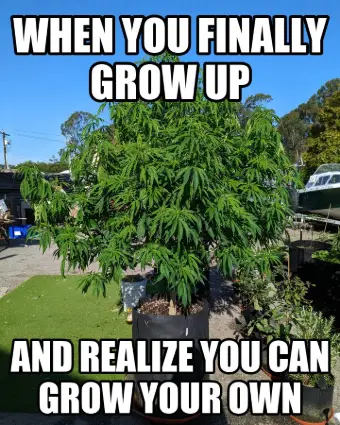

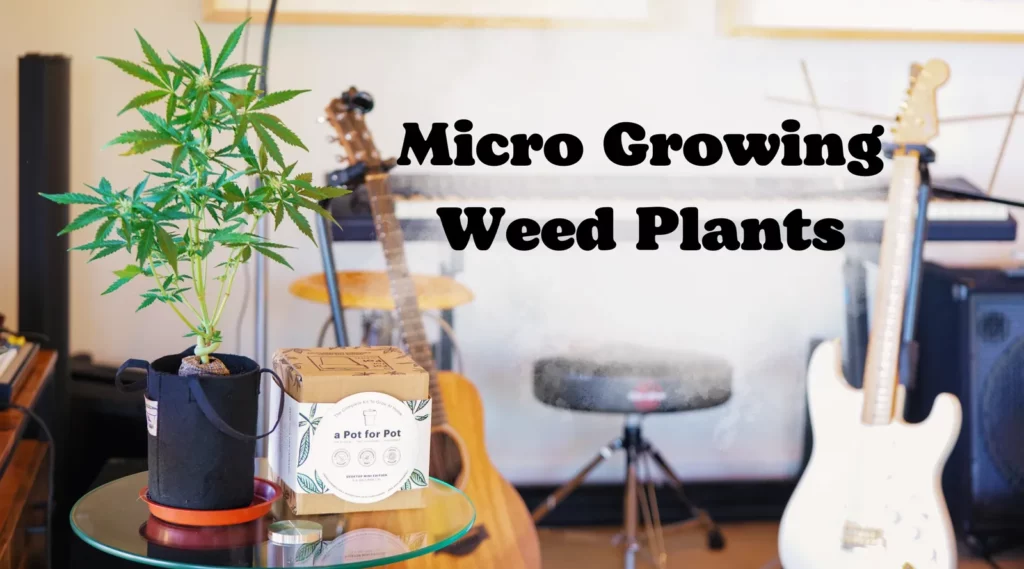
There’s nothing more impressive than a full-size female cannabis plant. Towering overhead at 12 feet tall, buds swaying in the breeze, full-size plants are awe-inspiring. But their full potential is, indeed, full, and impractical for most home cultivation spaces. And let’s be clear- just because you don’t have 15-foot ceilings inside to grow giant plants doesn’t mean you can’t grow exceptional micro cannabis plants.
In fact, there is no space too small to grow weed plants. Small spaces are just as capable of growing sturdy plants with thick stalks, big leaves, and dank, resin-covered buds. With the right care and nutrients, your popcorn buds can be just as THC-laden as the top colas are.
Why Micro Grows Weed Plants & How To!

Why Cultivate Small Cannabis Plants?
It’s not all about size when it comes to growing high-quality cannabis buds. You don’t need a massive grow tent, a commercial production facility, or a large garden to grow plants with delicious and potent flowers – you just need the right seeds and the suitable growing materials. With that, you can grow in a closet, a cabinet, an empty computer tower, or even just a corner of your room that may or may not already have houseplants.
Sure, giant weed plants are fantastic. But they’re not always practical, especially for the home grower, and tiny buds can have just as much THC as big ones. Small marijuana plants are easier to store, conceal, and manage – a trifecta for the busy home grower just looking to enjoy the labors of a green thumb.

How To Keep Cannabis Plants Small
Get the Right Seed Genetics
Some plants are naturally taller than others. If you’re working with a small cultivation space, seek out cannabis seedlings that are known to be short in stature and rich in flowers.
Autoflowering cannabis makes an excellent choice as its internal clock keeps it compact and ready to harvest in 80 to 100 days from planting the seed.
Tailor the Height of Your Lights
You’ll want lights fairly close to the plant. If your lights are too far away, the plants will stretch to reach them, making them taller. Conversely, if your lights are too close, they can burn fledgling plants. It’s a careful balance to strike, but it’s important to get it right.
The best light distance for your plants depends on what kind of lights you’re using (CFL, HID, HPS, or LED). Fluorescent lights and LEDs can work well in small spaces. Remember that you’ll also have to adjust the lights as your plants grow, so it’s important to get the distance right from the start. Grow lights with more blue light can help plants stay shorter, while red light can encourage plants to get bigger. But keep in mind that cannabis grows best under a full-spectrum light source.
Trim Your Plants Properly
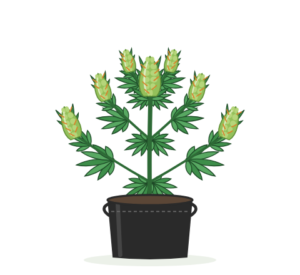
Topping your plant is one way to control the height. Topping refers to the trimming method of cutting the main stem, where the largest kola would develop, to divert plant resources to secondary branches and shoots. (Shown below) Topping not only allows you to control the height of your plant, but it can also create more bud sites and give you a higher yield in harvest. This pruning allows the plant to focus her efforts more equally across all of her flowers, not just the one on top.

Low-stress training (LST) can also be an effective way to keep your cannabis plants small. With low stress training, you can create a bushy plant that grows wider than it does tall. Tying the smaller branches away from the plant can easily be done in the vegetative phase. These branches will continue to grow but will focus on moving out rather than up.
Know When To Induce Flowering
If you’re growing a feminized photoperiod plant, they typically double in size during the flowering phase. Keep that in mind as you plan your light schedule – don’t wait too long to switch to a 12/12 light cycle. Flipping photoperiod plants early keeps plants shorter.
The Best Setup for Micro Growers
While grow tents are favorable with many home growers, you don’t need to invest thousands of dollars into one to have a successful home grow, particularly micro-growing with a small space. You don’t need a grow tent at all. You need:

The right pot size is especially important for a micro grow. The size of the pot limits the size of the plant by limiting the amount of space the roots have to spread out. Some people even use an 8 oz solo cup as a pot for tiny plants! (We don’t recommend this, however, as the plastic material will impact water draining and root health.)
Smaller pots are especially important if you’re working with a photo-period strain in a small space. These strains will grow in the vegetative phase for as long as you let them. Having a small pot limits the amount of space the roots have to grow, impacting the height of your herb.
Temperature Matters for Small Weed Plants
The temperature and humidity are important for a grow of any size. Indoor cannabis plants must be kept between 68°F and 82 degrees Fahrenheit. Much hotter and the plants will get heat stress. Colder and the plant’s metabolism will slow down. This will cause stunted growth during the seedling and vegetative stage, but not the kind you want! Cooler temperatures during the late flowering stage can be okay provided they don’t go lower than 50 degrees F.
Circulate the Air in a Micro Grower
Concentrate on airflow. In a small, warm space, mold and bacteria can easily proliferate. No matter what the size of your cultivation space is, you need fresh air and you need to move it around. Most grow tents have the option to bring in fresh air and expel old air, but a simple oscillating fan will also do the trick. Our favorite is from AC Infinity. In a small grow space, there is less room for the air to move, so make sure you move it.
The Best Strains for Small Cannabis Plants
One of the determining factors in how large a marijuana plant gets is its genetics. Some genetics are taller, bushier, or leafier than others. If you have a small space, you can set yourself up for success by selecting a strain known for producing potent, dank buds on a small stalk.
The best small weed plants start with feminized cannabis seeds. Since small grows limit the number of plants you can have, it’s important that you have female plants that will produce flowers. Male plants waste valuable growing space, so skip the headache and start with feminized seeds for female plants.
Secondly, some cultivars are naturally taller than others. Super-sized hybrids and skyscraping plants can be frustrating to contain. While professional growers prefer photoperiod flowers for the control it gives, an autoflower is ideal for a small home grow setup.
That is not to say that photoperiod flowers don’t work for microgrows. They absolutely can! However, they require far more management as you have to move the plant between the different phases. If you let a photoperiod plant spend too long in a vegetative phase, it will get as big as it can! Having the proper pot size and not letting the plant veg for too long are important for growing photoperiod plants in a small space.

What’s an Autoflower?
Autoflowering cannabis plants are plants that have been crossed with the Cannabis ruderalis strains. Cannabis indica and Cannabis sativa are well known, but Cannabis ruderalis is under-appreciated.
Ruderalis plants are from cold, mountainous areas where sunlight is limited. Unlike photoperiod sativa and indica, ruderalis plants are auto-flowering to make the most of the short growing season. When mixed with your favorite strains, autoflowering plants start budding after a certain number of weeks (usually around 4 weeks or 30 days) regardless of the light or feeding schedule.
Any strains listed as “fast”, “express”, or “short” is a good answer to the question, “What small plants can I grow indoors?” These strains are strong candidates for growing in a small space because they typically have a fast-flowering period.
Five of the Best Small Cannabis Strains include:
- Royal Dwarf. A short and stout autoflower is the perfect place to start for a beginners grow in a contained space.
- Quick One. Small and fast-growing, this hearty strain is ideal for tiny indoor grows. It can tolerate a little neglect, making it perfect for a grower who’s just getting their hands dirty.
- Diesel Automatic. Aromatic, compact, and legendary. Diesel automatic is a cross between the diesel flower you know and love, and the ruderalis strain of cannabis known for its autoflower properties. What’s not to love?
- Critical Kush. A balance of CBD and THC is present in this shorty strain, which has a large flowering capacity given its short stature.
- Haze Berry. This strain boasts a small stature and consistent yield, making it perfect for growers of all experience levels.
3 Common Techniques for Small Cannabis Plant Cultivation
There are many ways to manipulate your marijuana plants to keep them small. We’ve discussed a few pruning methods above, which include topping your plants and using low-stress training. Other methods include: Sea of Green, Screen of Green, and Supertopping.
Sea of Green Technique
Sea of green is a common technique used to maximize your harvest yield while growing in a small space. In the sea of green method, you would grow many plants together in a small area. Because the plants are forced to share space, they grow together to create a canopy of buds. Typically, each plant would focus its energy on growing the main bud, also called the cola. This method can induce flowering faster since each plant is only working on one cola. The sea of green technique requires smaller pots and a net to help support your plants during flowering, but there is no pruning, topping, trimming, or training required.
Screen of Green Technique
The screen of green, or ScrOG, method restricts the plant’s vertical growth to force the branches to grow horizontally. With this method, you need a screen strong enough to support your plants and big enough to weave the branches through. As the plant grows, the taller branches are weaved down and out around the screen while the lower branches are tied up and out. This brings the branches to an even height to create a level canopy. Topping and trimming are necessary to create enough space and maximize light exposure.
Supertopping
The supertopping method bends plant branches to prevent them from growing taller. The branches are bent, usually at a right angle, without breaking them. This is different than the topping method, which involves cutting off the largest node of the cannabis plant.
Start Your Growing Journey With Our Indoor 2 Gallon Grow Kit Today!
Growing a Small Weed Plant, From Location to Flowering
Once your small-space setup is ready, here is the order of work for a single small plant, from choosing a location to flowering. Light and soil are covered in the setup section above.
1. Select Your Location
You can grow cannabis either indoors or outdoors. An indoor setup provides total control over the growing process, such as how much light the plants receive. However, indoor growers carry a lot of responsibility, since the plants depend entirely on the grower for their survival.
Alternatively, you could grow your plants outdoors. This option is less expensive because nature does a significant portion of the work, such as providing sunlight. However, outdoor grow sites are not as private as many people would prefer, and growers often have to contend with the risk of their plants being stolen or even trampled by animals.
Think about the pros and cons of growing indoors or outdoors before you start, then select the option that works best for you.
2. Select Your Nutrients
It is easy to grow a cannabis plant, but nutrients can improve the end results. Use specific nutrients that help your plant thrive during the different stages of its growth. Those nutrients should be formulated for the medium you have decided to use, because certain nutrients only work in hydroponic systems, while others are designed for soil.
You will also need to consider the pH of your water. If the pH is incorrect, the nutrients cannot be absorbed as well. The pH should be appropriate for the medium that you choose.
Nutrient and pH levels can be complicated, and a hassle when you only want to grow a single plant. A much easier solution is a Pot for Pot grow kit. Kits are designed to make growing a single plant simple, and they include the soil and nutrients, so you do not have to spend so much time on this step. For more on feeding, see our guide to fertilizers and nutrients.
Related: Grow Your Own Weed: A DIY Guide for Beginners
3. Pick Your Strain
Now is the time to use what you have learned about indicas, sativas, hybrids and autoflowering plants to decide what you would like to grow. Do you want a shorter growing period, or do you not mind plants that take longer to mature? Are you interested in smaller plants or ones that grow really tall? These questions will narrow your options and give you a clearer idea of which strain to select.
As for obtaining the actual plants, you could start with seeds or small starter plants. a Pot for Pot sells feminized seeds if you decide to start with seed. You could also buy starter plants from a dispensary or breeder near you. If you know a grower who has the type of plants you want, see if you can obtain clones from that individual.
4. Germinate Your Seeds
This step only applies if you are growing from seed. There are plenty of ways to germinate a seed, but a premade seed germination kit is the easiest option. To use it, you only need to moisten the medium, insert the seeds and water as needed. Once your seed sprouts, you can place the entire medium into your pot for easy transplanting.
5. The Vegetative Stage
Once your seedlings develop a pair of leaves, they have officially entered the vegetative stage. This is the time when cannabis plants have the singular purpose of growing bigger and stronger in preparation for the coming flowering stage.
During the vegetative stage, plants need plenty of light, around 18 hours. Keep the grow space a bit warmer than room temperature, within the 68°F to 82°F range covered in the temperature section above. Long hours of light and warm temperatures mean your plants will need plenty of water, so monitor the moisture level and adjust accordingly. You do not want your plants to be too thirsty.
6. The Flowering Stage
When flowers start to form, you have entered the flowering stage. This phase lasts until you harvest the mature buds. Here is what to expect:
- Training. Your plants will get large and bushy. You may want to train them by trimming and bending so there is a flat canopy on top, which lets light reach all parts of the plant. This is an advanced technique, so read up on it before you try it.
- Confirm the sex. If you did not purchase feminized seeds, or you are unsure of the sex of your plant, confirm that it is female. Look at the junction of the branches for wispy white strings emerging. If these wisps are present, the plant is female. If they are not present, what is growing is a pollen sac, and the plant is male.
- Light schedule. Photoperiod (regular) plants need 12 hours of light and 12 hours of darkness each day. Autoflowering plants do not depend on a change in the length of daylight hours to start flowering, so this step is not required with those seeds.
- Temperature. The flowering stage calls for cooler temperatures than the vegetative stage.
- Flush. If you used any nutrients, give the plants a little extra water to flush those nutrients out of the plant’s system. This helps with taste and aroma.
- Watch your plants. Plants in the flowering stage are rather sensitive to the conditions they are growing in. Look for signs of a problem, such as brown leaf tips, which could point to a problem with watering, lighting or nutrients.
FAQs about Growing Small Marijuana Plants
Can you grow a small marijuana plant indoors?
Yes, you can. The size of marijuana plants is determined by genetics, environment, and care techniques. If you have a small grow tent, you can keep your plant small by topping it and giving it low-stress training. Similarly, if you have a shallow pot and the plant’s roots can’t get deep enough, you’ll have a smaller plant.
Small plants are often considered easier to grow indoors because they’re easier to conceal and contain. A 10-foot plant is pretty obvious in your living room, but a two-foot plant hidden away in a grow tent or in a closet won’t attract unwanted attention. While small plants have a reputation for producing popcorn buds rather than colas, these nugs can still have crystal like texture and potency from trichome production.
Are small marijuana buds less potent?
Absolutely not! When it comes to weed plants’ potency, size doesn’t matter – the trichomes do. Sure, everyone loves the cone for its density and showmanship, but if you’re topping your plants to keep them short, you’re spreading the trichome production out. Small popcorn buds can pack just as much power as big ones as long as they’re resinous, well-cured, and stored properly.
Are popcorn buds worth it?
Popcorn nugs are the smallest buds found on the lower parts of a growing marijuana plant. Popcorn cannabis buds tend to be smaller than b grade buds and sometimes less dense because they get less light from being shaded by the taller parts of the plant. Popcorn buds can be tricky to trim, but they have the same potency whether you turn them into edibles or just pack one into a bowl.
How much light do small marijuana plants need?
It depends on how many plants you’re growing and what types of lights you have. There is a proper light-to-plant ratio for each size grow space. The minimum wattage a cannabis plant needs to function is around 35 watts. We have found that a 36 watt LED bulb is perfect for the desktop cannabis micro grow. The more light and the stronger the light, the bigger and denser the marijuana buds.
What does a small female marijuana plant look like?
A small, mature female marijuana plant looks a lot like a big one! Mature plants have thick stalks, fan leaves, and multiple nodes where flowers and sugar leaves can bloom. Think of a regular marijuana plant and compress it down. They look like tiny plants, small trees, or compressed plants. In short, they look the same – just smaller.
What is the smallest cannabis plant?
Cannabis ruderalis is the smallest of the three cannabis varietals; ruderalis, sativa, and indica. Which strain produces the smallest cannabis plants is up for debate.
Are there miniature cannabis plants?
Yes, there are. You can select certain strains that have been bred to produce the most nugs with the least height possible. See the list above for some strains that have been bred for the shortest flowering height.
You can also grow a canna-bonsai tree, an individual cannabis plant that is cared for and trimmed to resemble a Japanese bonsai tree. Just as traditional bonsai trees are miniature versions of their large counterparts, so too canna-bonsai trees are miniature cannabis plants.
What’s a canna-bonsai tree?
A canna-bonsai tree refers to the craft of cultivating a single cannabis plant into the shape of a bonsai tree. These plants are functional and flower, but are smaller than traditional cannabis plants. Think of a desk-size plant producing a regular-size nug.
What can I do if my marijuana plant is too tall for my grow space?
If you have a plant that’s about to out-grow your grow space, there are steps you can take to try to contain it. Supercropping or extreme bending is one way to spread the branches of your plant out. Supercropping your plant involves bending branches at right angles without breaking the steams. This allows growth to continue without the plant getting taller. You can also top the plant, removing the tallest node. This makes the plant shorter and forces trichome production throughout the smaller branches, which would otherwise produce tiny popcorn buds. //